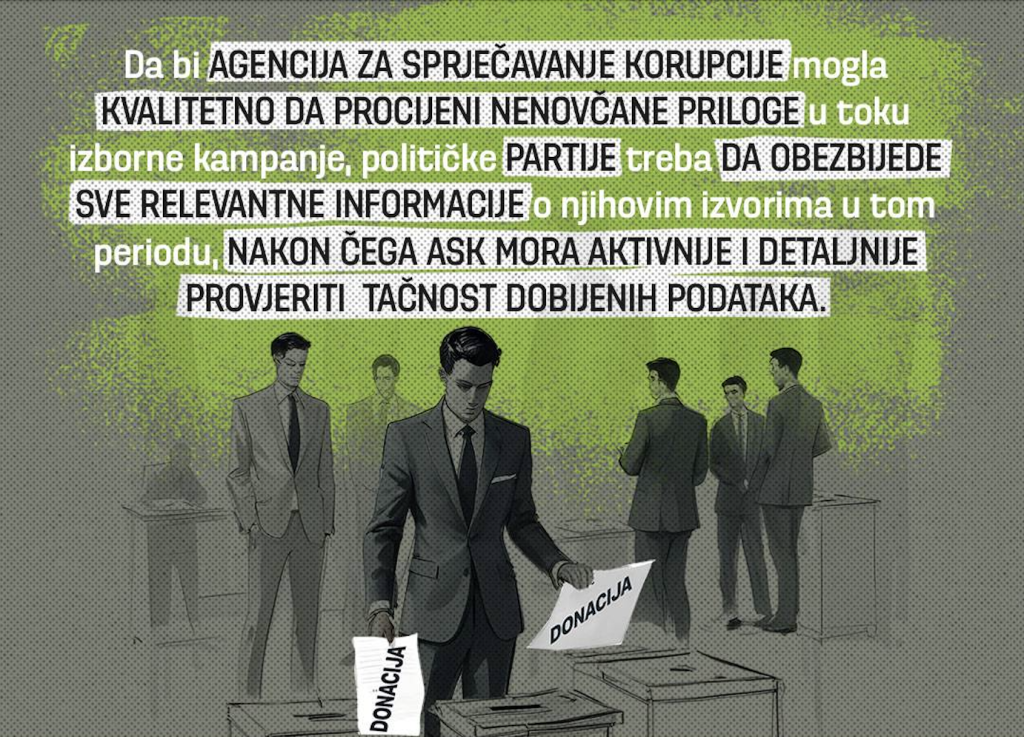
In order for the Agency for the Prevention of Corruption to effectively assess non-monetary contributions during the election campaign, political parties must provide all relevant information about their sources during that period. Following this, the Agency must actively and thoroughly verify the accuracy of the received data.
Non-monetary contributions and donations are among the most problematic issues when it comes to transparency. On the other hand, due to the lack of an adequate methodology for assessing these contributions, effective oversight of the implementation of legal provisions is absent.
Given that a comprehensive electoral reform process is underway, UZOR has prepared Methodological Guidelines for the Assessment of Non-Monetary Donations during the Election Campaign, outlining the procedure that the Agency for the Prevention of Corruption should implement.
The document is designed as a foundation for defining new legal solutions and proposals to improve the rules for monitoring election campaign financing, including specific examples for volunteer work, services, media space, equipment, and facilities.
Thus, a priority activity for the Agency is identifying possible sources of non-monetary donations during the election campaign, followed by recording and verification, as well as assessing the value and controlling the reported contributions.
It is also necessary to define a clear methodological framework that will be presented to political entities in the context of reporting on non-monetary donations.
The Methodological Guidelines were prepared as part of the project “Electoral Reform in Focus: It’s Time!” which UZOR is implementing in collaboration with the Center for Democratic Transition (CDT) and the Association of Youth with Disabilities (UMHCG), with support from the European Union.