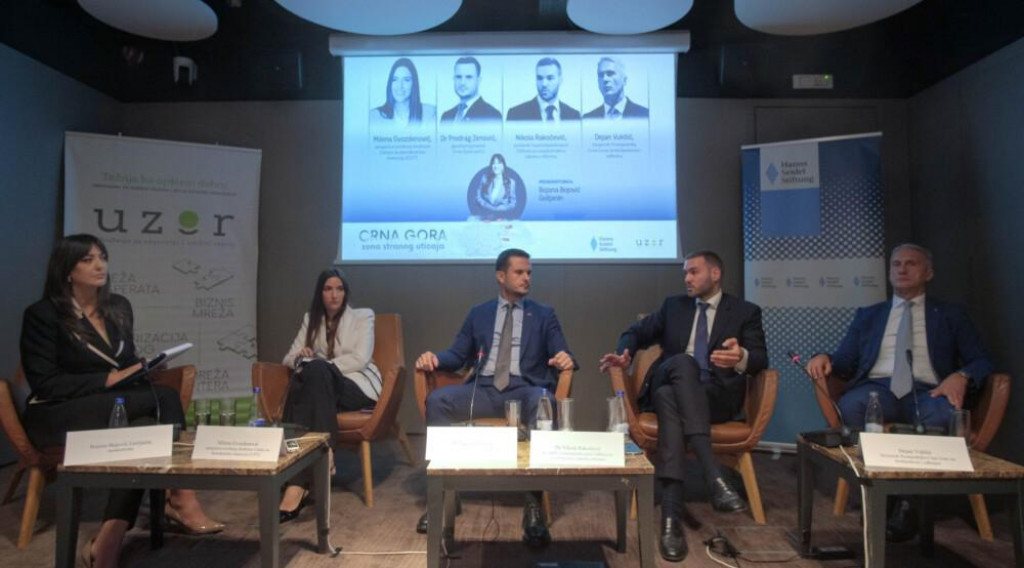
Montenegrin laws and institutions currently lack any mechanisms for preventing or combating negative foreign influences, it was concluded at the roundtable titled “Negative Foreign Influence: Is Montenegro an Easy Target for Major Players?” organized today by the Association for Responsible and Sustainable Development (UZOR) at the CUE Hotel.
In his opening speech, UZOR’s program director, Marko Pejović, stated that Montenegro has become a perfect zone for negative foreign influences due to ongoing political and religious turmoil, as well as the overproduction of online media outlets that lack transparent ownership and editorial structures but have a clear political agenda.
Dr. Klaus Fiesinger, Regional Director for Southeastern Europe at the Hanns Seidel Foundation, emphasized the importance of European integration as a stabilizing factor and a countermeasure to anti-Western influence, noting that “EU perspective is key for promoting democracy, the rule of law, and progress in Montenegro.”
On the panel titled “Between East and West,” DPS MP Nikola Rakočević argued that certain parts of the government are blocking Montenegro’s European path by using sophisticated tools. He explained the difference between the influence of the US and the EU, which, in his view, is what Montenegro has sought, while Russian influence, on the other hand, is malignant. He emphasized that Serbia can have a positive impact on Montenegro’s economic activities, but the problem arises when political influence is involved.
When asked to comment on the proposed Foreign Influence Agents Law, promoted by the ZBCG coalition, Chief EU Negotiator Predrag Zenović stated that it is an anti-European initiative that should be abandoned as soon as possible.
Commenting on the UZOR survey which revealed that 43.7% of citizens believe that the political situation is heading in the wrong direction, Montenegrin President’s Advisor Dejan Vukšić noted that citizens had expected more from the fight against organized crime, and this dissatisfaction has contributed to their discontent.
Milena Gvozdenović, Deputy Executive Director of CDT, mentioned that elections in Montenegro are conducted by a politicized administration, campaigns are full of disinformation, and there is no data on transparent financing. She explained that bad laws in Montenegro serve the interests of negative financial, political, and media influences, and that despite the clear interference of Russia and Serbia in the country’s electoral processes, Montenegro behaves “as if it has nothing to defend.”
The event was organized in partnership with the Hanns Seidel Foundation as part of the project “Strengthening Social Resilience in the Digital Era.”