Funds Exclusively Intended for Women’s Organizations Misused by Political Parties Without Legal Consequences
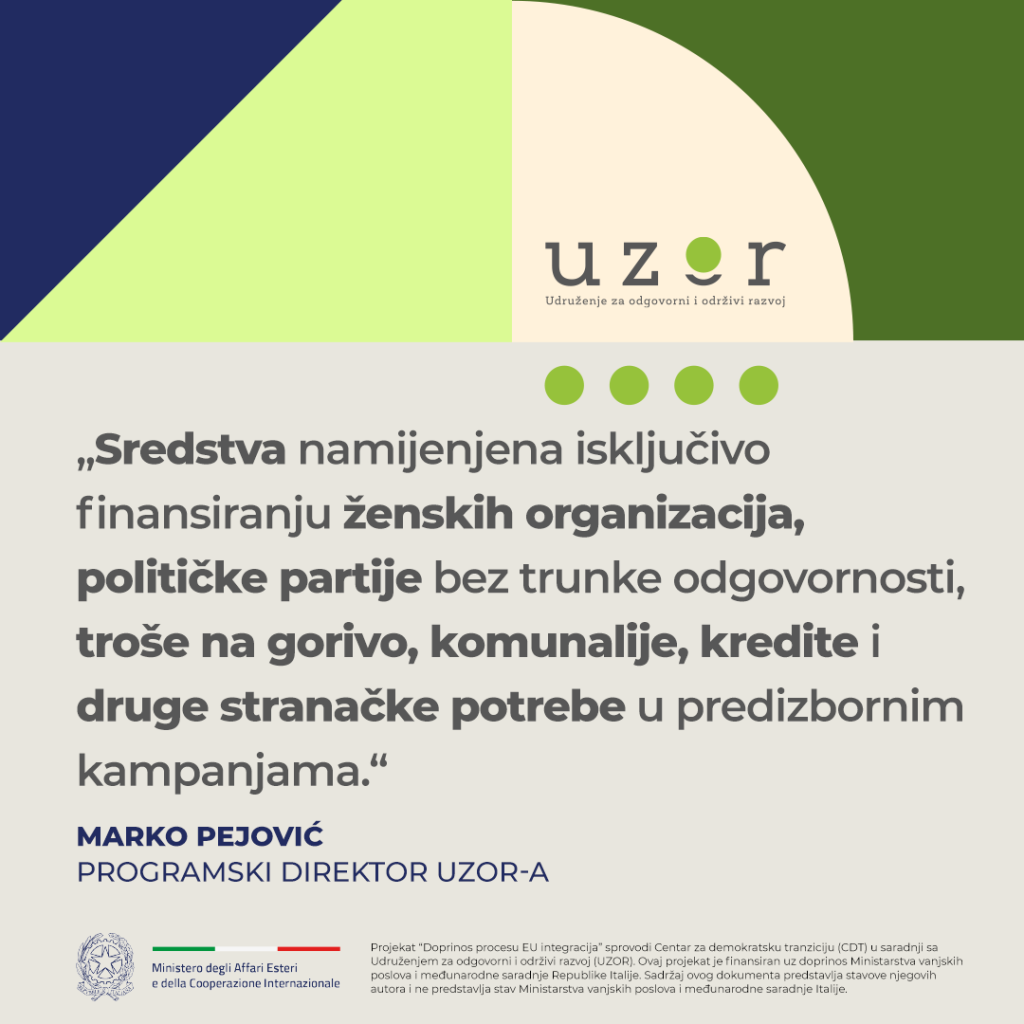
Funds that are meant exclusively for the financing of women’s organizations are being used by political parties for fuel, utilities, loans, and various other party needs during election campaigns, without any legal repercussions.
This is one of the main conclusions of UZOR’s analysis of the Law on the Financing of Political Entities and Election Campaigns, titled “Funding of Political Entities and Election Campaigns Under Scrutiny: Challenges and Solutions.”
Although political parties have been receiving funds since 2020 to systematically empower women to take on significant roles in the country, ambiguities in the current law allow for obstacles to women’s political advancement to be created within their closest surroundings.
In 2024, nearly 700,000 euros are allocated exclusively for financing women’s organizations within political entities and can only be spent in accordance with the statutes of those women’s organizations.
However, the provision aimed at stimulating women’s political engagement lacks sanctions for non-compliance, leaving room for the misuse of “designated” funds, posing a risk that they could be used for the regular operations of political parties or during campaigns.
Given that the existence of a law without adequate sanctions undermines its essence, UZOR recommends that urgent penalties be established for violations of the law to prevent the misuse of “designated” funds and ensure that women can progress politically without obstacles.
The analysis of the current Law on the Financing of Political Entities and Election Campaigns has revealed that, in addition to this issue, there is significant potential for political abuses concerning social welfare payments.
Therefore, it is necessary to legally define the terms “social welfare” and “social assistance” to eliminate the possibility of discretionary interpretation of such a sensitive provision.
It is also essential to introduce more transparent and precise control mechanisms for the allocation of these funds, especially in years when local and parliamentary elections are held, where it is stipulated that such payments are only permissible in cases of war, emergency, or during an epidemic or pandemic of infectious diseases.
The complete analysis was prepared by UZOR as part of the project “Contributing to the EU Integration Process,” implemented in cooperation with the Center for Democratic Transition (CDT) and supported by the Ministry of Foreign Affairs and International Cooperation of the Republic of Italy.
Marko Pejović, Program Director of UZOR